



Key Summary
- Solicitor SEO isn’t dead - it’s evolving. Despite AI overviews and directories dominating results, clients are still searching for legal services online, and the firms that adapt continue to win high-value cases.
- Local visibility is the biggest opportunity. Google and AI tools increasingly prioritise nearby firms, making an optimised Google Business Profile and local SEO your strongest competitive edge.
- AI search is reshaping discovery. To appear in ChatGPT, Perplexity, and Google AI Overviews, firms must strengthen their EEAT signals, build consistent mentions across trusted sources, and ensure content clearly answers client pain points.
AI Overviews, directories, and costly paid placements now dominate prime space in search results for some phrases, pushing traditional organic listings further down – and if you’re not visible in the right places, you’re not even in the race.
But the truth is: solicitor SEO is far from dead.
There are still huge opportunities to generate new cases through search engines if you focus on what’s working now (yes – even in this AI age).
Clients are still turning to search when they need legal counsel and don’t already have a firm in mind and showing up in those moments is where the wins happen.
The state of Solicitor SEO
The chances are you’re already doing SEO, but you’re starting to see a decline in leads due to AI overviews clogging up the search results.
It’s true that there have been huge changes to search results in recent times as AI overviews and other search features push out traditional results, but there are still untapped ways to generate leads for solicitors (which we’ll come to) via search.
For now, these monthly search numbers (the number of times these phrases are searched for in Google) indicate that Google search is very much alive, and there is still plenty of opportunity to capture leads with SEO.
Solicitors who are visible at the top of search results consistently get the lion’s share of the cases.
Typically, we find that:
- Traffic from search is abundant for solicitors and converts the highest
- Traditional ads like bus benches, radio, and billboards get minimal attention.
- Organic social media is often great for awareness, but it’s a big lead generator.
- Paid social media advertising is gaining traction in the legal sector, but doesn’t convert as well
- Google PPC ads for lawyers can be expensive to run.
So, how would we do SEO for solicitors in 2026 when search results are littered with AI? In this guide, we’ll talk through:
- 1.The different types of searches your customers are using
- 2.The best and perhaps most underused strategy for generating solicitor leads
- 3.The most important activities solicitors can do to generate leads via search.
- 4.What is needed to surface your law firm in the age of AI search (AI mode, ChatGPT etc)
First off, let’s dispel the myths
- 1.You don’t need to be a leading law firm to generate leads via Google – It’s a misconception that the top law firms are dominating the space. Whilst it counts for something, we’ve found that there are opportunities for all.
- 2.Solicitor SEO isn’t dead – your potential customers will always be searching for a law firm, whether on Google or ChatGPT
- 3.Local visibility is your biggest competitive advantage – Google is actively prioritising nearby firms in both traditional results and AI Overviews. By focusing on your Google Business Profile and local optimisation, you can outrank bigger national names in the moments that matter most.
What is SEO for solicitors? Redefined for 2026
Solicitor SEO is the process of improving your law firm’s search visibility so potential clients find you when they search for legal services, regardless of where they search. It involves optimising your website, Google Business Profile, and online presence to rank higher in search results, whether that’s for local keywords like “family solicitor near me,” national terms like “corporate solicitors,” or in AI-driven results like Google’s AI Overview or ChatGPT.
Forgetting all of the technical in’s and out’s – these activities are a means to the end. SEO is an investment in generating qualified leads your law firm.
The goal is simple: appear in the right place, at the right time, for the right searches, and turn that visibility into new cases for your firm.
Now, let’s look at the different types of searches your clients carry out.
National Searches
What is national SEO for solicitors?
National SEO focuses on ranking for broader, non-location-specific keywords across the whole country, for example, “corporate solicitors” or “High Net Worth Solicitors.”
How these search results are changing – and why it’s time to adapt
National results have been impacted by AI Overviews, which often surface only a handful of firms or legal directories at the top of the page.
Unless you operate in a highly specific legal niche, national visibility is slowly being eroded as Google increasingly mixes local businesses for broad legal searches.
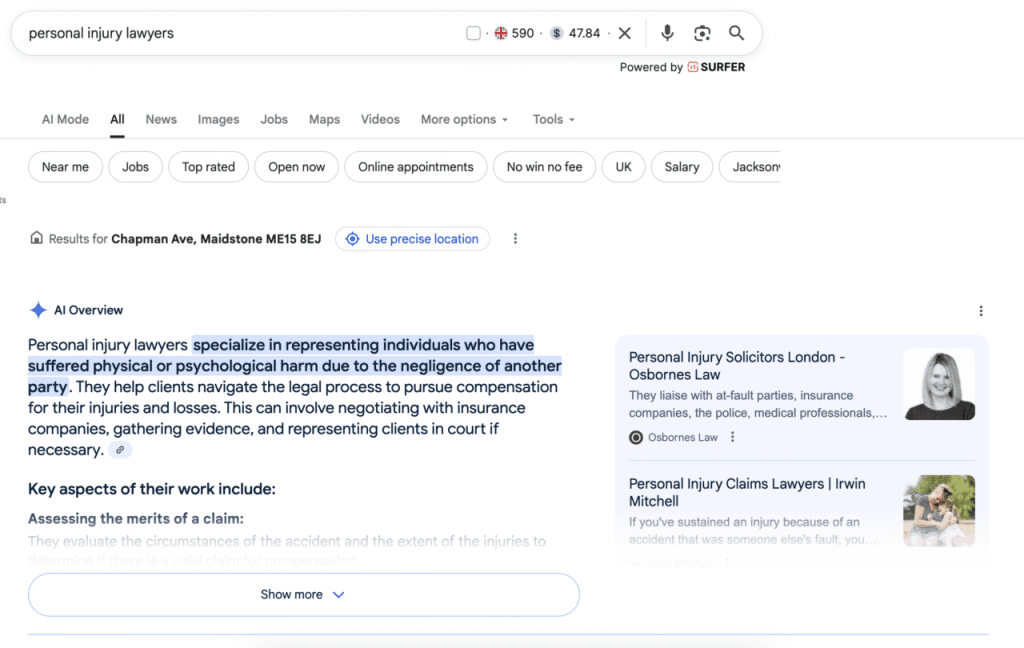
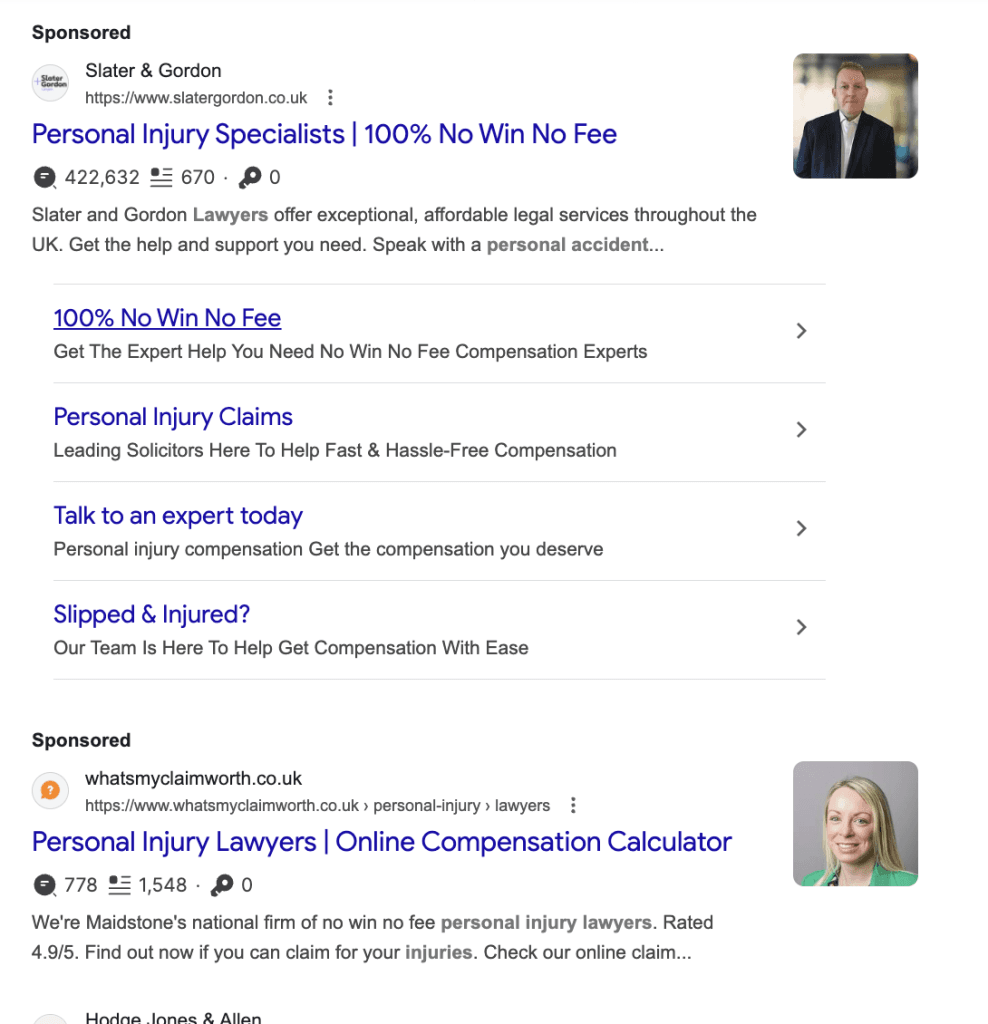
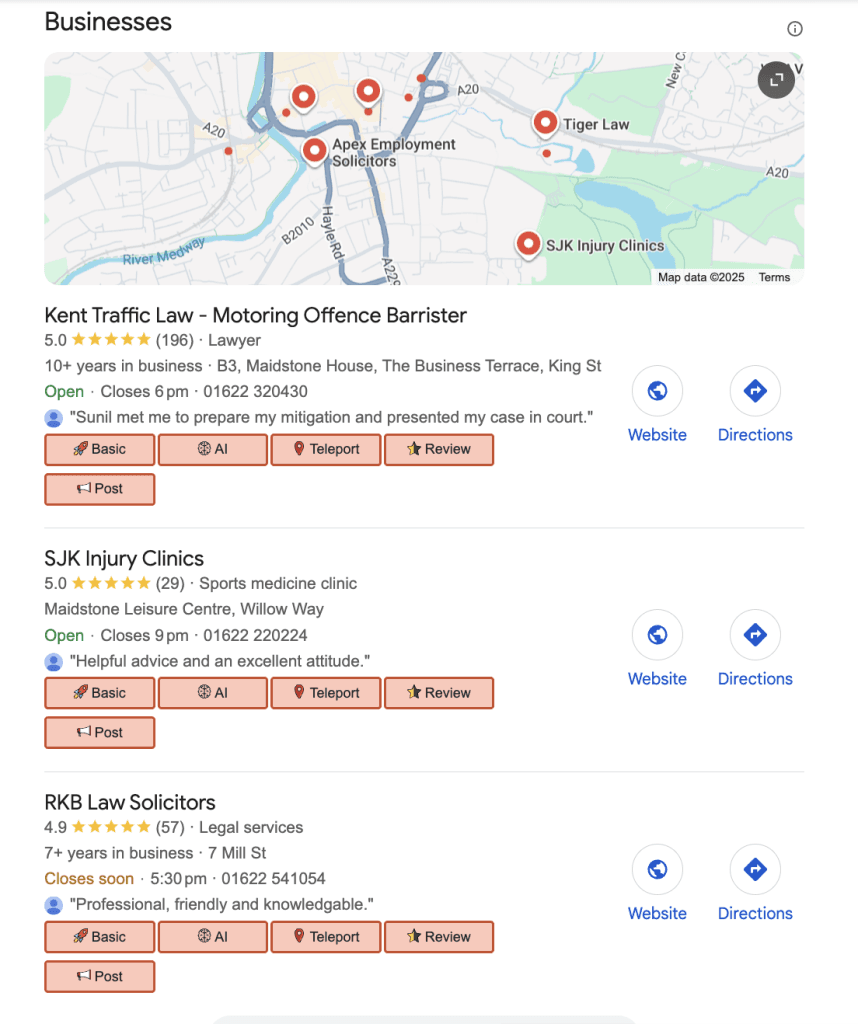
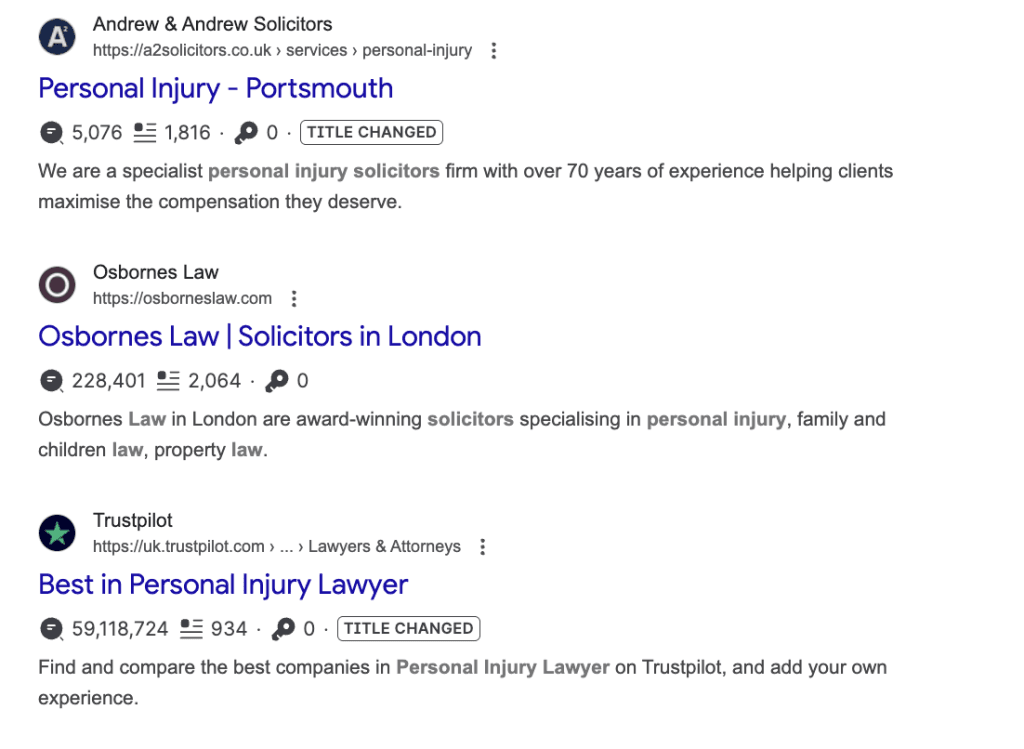
This shift makes it harder for individual law firms to compete nationally if they neglect their local efforts. For example, if you search for personal injury lawyers, you’ll see get:
1. AI Overviews
2. Google Ads
3. The map pack with local businesses in close proximity
4…and finally, the traditional blue links with both local and national businesses
Some law firms set their sights on national appeal, and if you’ve got the brand recognition, marketing budget, and niche expertise, that’s still achievable.
But the reality is shifting. Outside of very specific areas of law, national search results are steadily losing ground, with Google increasingly recommending local firms even for broad, non-location-based searches.
That means firms chasing a purely national strategy could be missing out on high-quality leads in their own backyard, so to speak.
AI Overviews often amplify this trend by prioritising local businesses or directories, making it even harder to dominate national results.
Local searches
What is local SEO for solicitors?
Local SEO focuses on ranking for location-based keywords and appearing in searches where proximity is a key factor, for example, “family solicitor in Manchester” or “conveyancing solicitor near me.” The goal is to make sure your firm shows up prominently in the Google Map Pack, localised organic listings, and AI-generated results that recommend nearby businesses.
How these search results are changing
Here is where the lead generation gold is. Local SEO has become more valuable than ever as Google increasingly integrates local business results into both broad and specific legal searches.
Even queries without a location mentioned often return a map pack and nearby solicitors first. AI Overviews reinforce this trend by pulling in recommendations from local firms, reviews, and regional directories.
For example, if you search for “divorce solicitor,” you’re likely to see:
- Google Ads for local firms
- A local map pack showing solicitors within your area
- Review sites like ReviewSolicitors or Trustpilot
- People Also Ask questions
- Organic results with local businesses
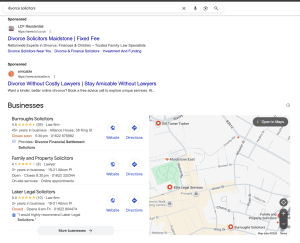
For many law firms, this presents a major opportunity. Local SEO allows you to compete on trust, proximity, and reputation rather than solely on brand scale or marketing budget.
By investing in optimised Google Business Profiles, location-specific landing pages, and local citations, you can secure high-intent leads who are actively looking for legal services around your key locations, often with far less competition than in national searches.
You can only be surfaced for local terms if you have a physical location in the area. That’s why we believe that in 2025, your physical locations will be your biggest asset when generating leads via Google. This presents a big opportunity for multi-location law firms to double down on their local strategy – something that many firms have neglected to do in the past in favour of national visibility.
AI Search
What is AI search for solicitors?
AI search is where tools like Google’s AI Overview, Microsoft Copilot, ChatGPT, and Perplexity generate an answer recommending solicitors.
Contrary to popular belief, AI tools don’t exactly know your brand. These models understand “entities” which are the people, businesses, and topics they recognise and how they are associated with each other based on mentions across the internet.
They collect information about your firm from a wide range of sources online, known as training data, which can include your own website, reviews, legal directories, press coverage, and even competitor comparisons.
When a user is looking for a recommendation for a law firm, they run multiple searches on your behalf, collate the most relevant results, and present a final, condensed answer directly to the user.
Your potential clients will be using AI search more frequently
For solicitors, AI search is changing the visibility game. Instead of scrolling through pages of results, users now get a curated answer with a list of law firms mentioned.
Here’s a typical search, which is generally longer and more detailed: “recommend a personal injury lawyer in London that offers no win no fee” might return:
- A short summary of conveyancing services
- A few named firms with or without links
- Sometimes, links to the Google Business profile
- A more detailed explanation about why each law firm was chosen
Being featured in these AI summaries depends on the strength of your EEAT signals (Experience, Expertise, Authority, Trust), how regularly your firm is referred to on third party sites for specific practice areas, how clearly your content explains your service (i.e. no win no fee), and whether you appear in reputable, AI-cited sources.
Firms optimising only for traditional SEO should also benefit as AI search gains popularity. This is why we call AI visibility “SEO 2.5” – it’s not a replacement for SEO, but it builds directly on your existing SEO activities.
Should we pay attention to AI search? Yes. Whilst it’s in its early stages, we add specific AI activities to our workflow to make sure our solicitor clients stay visible in future iterations of Google or with increased ChatGPT usage.
How do we do SEO for solicitors in 2026 to generate new cases?
Given the evidence of the above, the money is where the prime real estate is in search results – in the maps pack or for local listings.
We take our clients on 8 key sprints to show up in this prime real estate and generate leads consistently. You can adopt these in-house or with your marketing team, or speak to a member of our team to help you implement this.
Our 9-Step SEO Roadmap for Solicitors in 2026
1. Optimise Your Google Business Profile (GBP)
For many legal searches, your Google profile is the first thing a potential client sees, not your website.
- Make sure each office has its own verified profile.
- Choose the right categories (primary and secondary).
- List services with short, clear descriptions.
- Add photos of your offices and team.
- Use the Q&A section to answer common client questions.
- Build a review collection process and reply to every review.
- Keep your profile updated with posts on legal changes, seasonal needs, or urgent services. Why it matters: A strong GBP is your ticket to the “map pack,” which drives high-intent enquiries.
2. Clean Up Your Website
Your site should be technically sound, easy to navigate and contain the correct page structure to be able to serve search engines highly relevant pages. That means:
- Fixing broken links, slow loading pages, and duplicate content.
- Making sure you have the correct local landing page structure for each service
- Prominently display your phone number, office addresses, and legal details number.
- Add clear terms, privacy policy, and complaints procedure.
- Use schema markup (LocalBusiness, LegalService, Person, FAQ) to help Google understand your site.
- Link related services and locations internally to guide visitors.
Pro tip: Your website is your “entity home.” It needs to clearly connect your firm, your solicitors, and your services in a way AI and Google can both understand.
3. Review Your AI Visibility
AI search tools like ChatGPT, Gemini, and Perplexity are influencing how clients find solicitors.
- Search your firm and practice areas in these tools. Note if you’re mentioned and how you’re being referred to.
- If the information is out of date, chances are it’s taking this information from the content on your site or from a third-party mention, so efforts should be made to correct these.
- Check which sources they cite and reach out to them if you’re not mentioned.
- Ensure your profiles on Chambers, Legal 500, the Law Society, and ReviewSolicitors are accurate and consistent.
Why it matters: AI results are often drawn from the first page of Google and trusted directories / sources from around the web. If you’re absent there, you’ll likely be absent in AI answers too.
4. Optimising Your Content to answer your clients’ pain points
On-page SEO in 2026 is about creating content that is highly relevant to your specific audience, not just placing keywords. Yes, that’s a bit of a generic statement – but so many law firm sites are missing out on enquiries because the content doesn’t do enough to address the problems and pain points of the reader.
- Structure pages with clear, scannable headings.
- Write in a language that your customer understands – not legal jargon
- Address the key problems that your clients are facing (rather than primarily writing about your law firm offering)
- Add FAQs based on real client queries to reduce any barriers to getting in contact.
- Include testimonials and case snippets directly relevant to the service they’re looking for.
- Use schema to mark up FAQs, services, and solicitor profiles.
Example: Instead of “We are experienced in family law,” write “We help clients through urgent child arrangement disputes, often securing agreements within X weeks.” Or if you’re in an area of law that is price driven, make sure you’re transparent about initial pricing and fees.
5. Create Location-Specific Content
Each office or city page should feel truly local:
- Create local pages for each service you provide
- Mention nearby courts, police stations, or hospitals.
- Add photos of your team in that location and who the reader is likely to be working with.
- Include relevant client reviews and case examples.
- Make opening hours and parking info clear.
- Embed a Google Map.
Why it matters: Clients trust solicitors who understand their area and its legal ecosystem.
6. Strengthen Your E-E-A-T (Experience, Expertise, Authority, Trust)
Search engines and AI tools prioritise trusted sources and your people, and other than external references, their expertise is your biggest source of trust. You can demonstrate this by:
- Publishing detailed bios for every solicitor.
- Linking to relevant memberships, awards, and directory listings.
- Adding detailed case studies and client outcomes (with client consent).
- Displaying third-party review scores.
- Keeping legal content up to date with “last reviewed” dates and citations.
Remember: In law, reputation isn’t just about the firm, it’s about each named solicitor and the experience they bring to the table.
7. (Optional) Run Local Ads
We often find that paid search, whilst it can be expensive, can fill the gap while SEO builds.
- Target ads for urgent services in your local area.
- Use call extensions for immediate contact.
- Send ad traffic to highly relevant landing pages (not your homepage).
8. Build Local Authority
Beyond rankings, you need visibility in the places clients (and AI tools) trust:
- Keep your details consistent across all legal directories.
- Build local citations from trusted, AI references directories.
- Contribute commentary to local press or legal blogs.
- Partner with local charities or community projects
- Seek coverage for noteworthy cases (within compliance limits).
Google isn’t being replaced just yet, it’s just getting noisier. Between AI Overviews, directories, ads, and new search features, the fight for attention has never been more competitive.
The key isn’t to chase every change, but to double down on the “protected” areas Google is actively prioritising now and in AI mode: local visibility and your Google Business Profile.
These are the assets that still command prime real estate in search results, drive high-intent enquiries, and are far less vulnerable to being pushed out by future updates. Get this right, and you’ll stay ahead of competing firms while continuing to generate a steady flow of new cases, no matter how the search landscape shifts.
9. Building Topical Authority Content
In 2026, creating in-depth blog content has become a bit of a contentious subject.
Why? Because AI Overviews in Google are starting to reduce the amount of “research traffic” that actually clicks through to solicitor websites. People can now get quick answers directly on the search page, meaning fewer visits from those purely looking for information.
That said, high-quality blog content is far from dead. In fact, it still plays two critical roles in a solicitor SEO strategy:
Even if informational blog posts bring in less direct traffic than before, they still pay dividends in rankings, brand reputation, and authority , all of which directly influence the visibility of your higher-value service pages.
SEO for solicitors works…. But it’s hard work – and that’s where we come in.
If you’re in new business development for your solicitor business, lead generation is just one aspect you need to focus on – not keyword research and technical audits. SEO can be your biggest source of leads, but doing it well takes time, consistency, and a clear strategy.
That’s why we recommend working with an SEO partner who knows the legal sector inside out, the way your clients search, the regulations you work under, and the competitive landscape you’re up against.
When you work with us, you’ll know exactly what you’re getting and what it’s worth to your firm. Get in contact with Tangible Digital today.
Frequently asked questions
SEO Ecomonics
How much should I spend on SEO each month?
Typically law firms can spend £2,000, whilst larger practices often invest £5,000+ monthly. However, the spend depends on the competitiveness of your practice area.
What’s the typical return on investment for law firm SEO?
Good SEO is a very high return activity, depending on the practice area. One new client from SEO often pays for months of SEO work. Personal injury and commercial law typically see higher returns than conveyancing.
A Manchester family law firm spends £2,000 per month on SEO. After 3 months, they rank well for “divorce solicitor near me” and similar terms. This generates 10 new divorce clients per month, each worth £3,500 on average. That’s £35,000 in fees from a £2,000 investment, a 17.5:1 monthly return. Even factoring in the first three months with no results, their annual ROI is still over 400%.
AI’s impact on Law searches
How does Google’s AI Overview impact solicitor SEO?
Google’s AI Overview can reduce the number of people clicking through to websites because it answers questions directly at the top of the search results. For many searches, this means less traffic for law firms. To avoid losing leads, focus on search phrases where AI Overviews don’t appear, such as specific legal services, urgent help, or local searches.
Will my firm appear in ChatGPT or other AI-powered search results?
It’s possible if you have great foundational SEO. AI tools collect information from trusted websites, news articles, and online profiles. If your firm is in these places, you have a better chance of being mentioned.
What’s the difference between traditional SEO and AI search optimisation?
Traditional SEO is about ranking on Google. AI search optimisation focuses on showing up in AI-generated answers, like Google’s AI mode or ChatGPT. The foundations to show up in these tools are the same, but with additional practices to help encourage visibility.
Keyword and Targeting Strategy
Should I focus on national keywords or local search terms?
National keywords work best if you have a strong brand or a niche service, however, Google does show local results for most national terms. Most firms should focus on local search terms first because they are easier to rank for and bring in clients near your specific practice areas.
Can my firm appear in search results for areas outside our physical location?
Yes, but not in the map pack. You can create pages for each location you serve and target nearby cities and rank in the traditional results under the map pack, but Google usually prefers firms with a real office in that area.
Website and Content
Do I need a blog to improve my solicitor SEO?
A blog is influential even though traffic to blog content is dying. What matters is having pages that answer your clients’ questions and show your expertise in your area of law.
Should each of my legal services have its own dedicated page?
Yes. This makes it easier for Google to match your page to what someone is searching for. It also helps clients quickly find the service they need.
Local Visibility
How important are client reviews for ranking in search results?
Very important. Good reviews on Google can improve your ranking and make people more likely to contact you.
What is the role of my Google Business Profile in attracting new clients?
It’s your online shop window. Many people will see this before your website. A strong profile with photos, services, reviews, and updates can bring in a lot of calls and enquiries.
What if your law firm operates in one area?
Google’s search results now include ads, maps, reviews, and other features before traditional website links. This means fewer people scroll down to the standard results. If you only operate in one area, you have an advantage, it’s easier to appear in the map pack and local results, which are shown first and get the most clicks. By targeting local phrases and optimising your Google Business Profile, you can secure more visibility without needing to compete nationwide.
Ready to bring in more cases and instructions?
Ready to bring in more high-quality cases? Book a free strategy call today and see how we can grow your firm’s visibility across every location.
- Outrank competitors
- Traditional and AI Search